Gandharva Kanya Mantra sadhana Diksha

Don't forget to subscribe! Youtube Post Call Now +91 9560160184
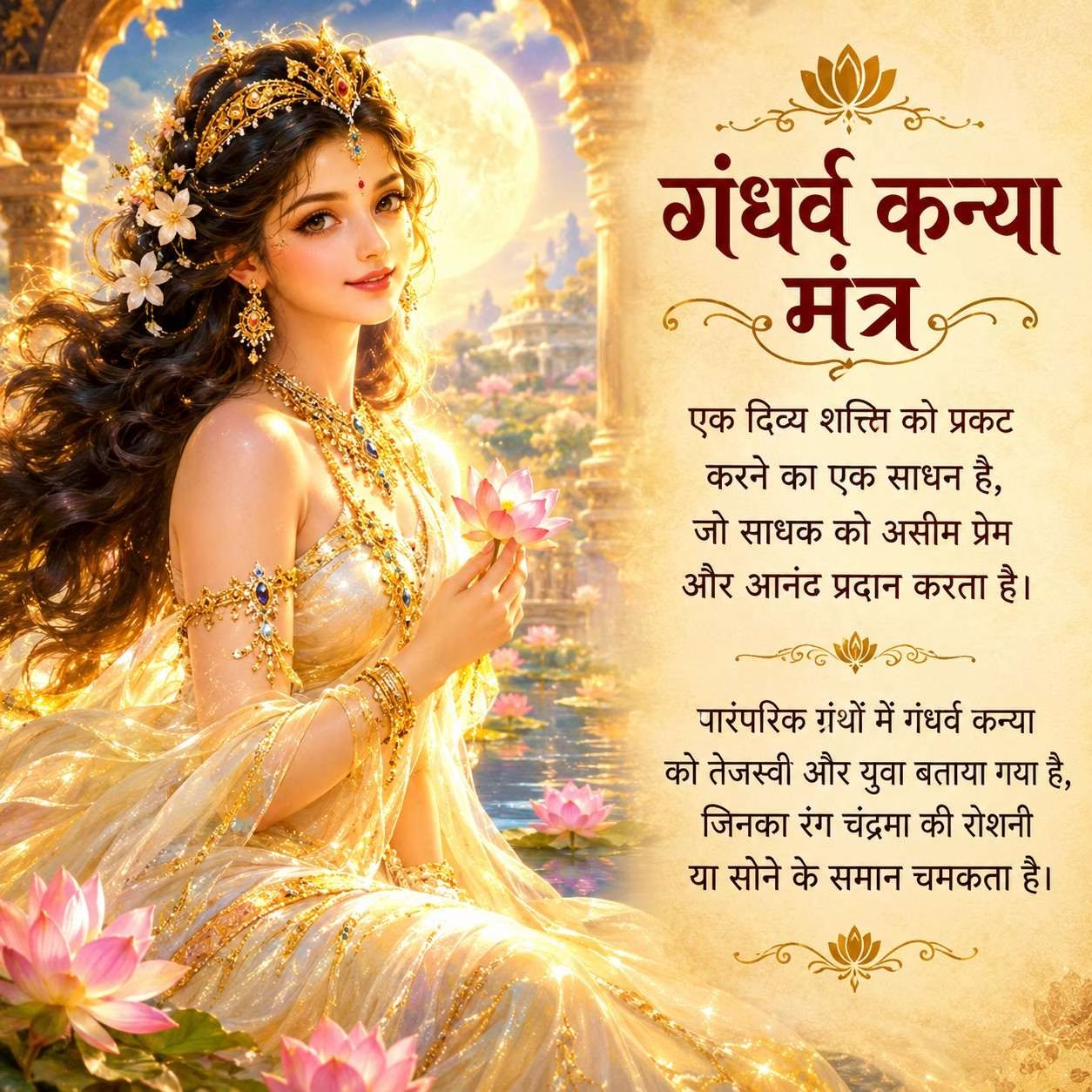
गन्धर्व कन्या मन्त्र
Gandharva Kanya Mantra is a divine tool to manifest the divine being. The ritual of Gandharva Kanya brings extreme love and joy in the life of the seeker.
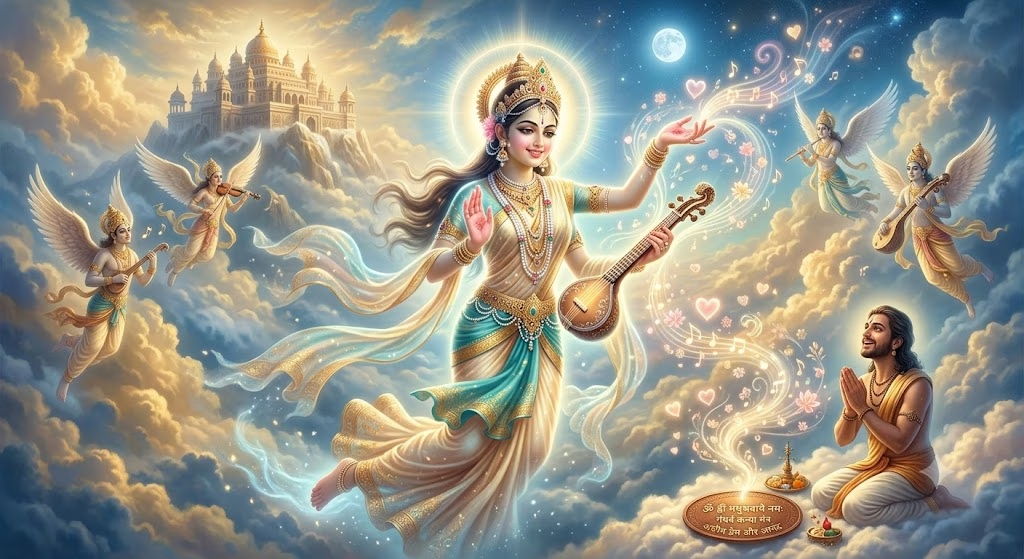
“Gandharva Kanya” literally means “Celestial Maiden” or “Daughter of the Gandharvas” in Hindu mythology, and it refers to heavenly beings noted for their beauty, singing, and dance.
Gandharvas are a class of semi-divine celestial beings who are regarded as the heaven’s greatest musicians, singers, and artists. They serve as a link between humanity and deities, primarily inhabiting Svarga (the celestial paradise) or their dedicated domain, Gandharvaloka.
They are the chief musicians in the court of Indra, the monarch of the gods. While masculine Gandharvas master instruments and voices, ladies Apsaras excel at celestial dance.
In early Vedic texts, they are entrusted with guarding Soma, the sacred nectar of immortality consumed by the Devas.
They are portrayed as stunningly attractive, fragrant people. Some are shown with bird wings or a horse’s head, representing speed and grace.
Traditional writings describe Gandharva Kanya as having a radiant, glowing complexion—often compared to moonlight or gold—and perfect, young features that do not age.
They are portrayed as thin, stunningly gorgeous, and naturally pleasant. In sculpture and art, they are depicted with flowing hair, expressive eyes, and an exquisite posture that reflects their dance backgrounds.
They are adorned in magnificent, brightly colored robes made of heavenly silks. They wear exquisite, shining jewelry—including crowns, pearl necklaces, and anklets that jingle to the rhythm of their movements.
While male Gandharvas are primarily the master musicians, a Gandharva Kanya is an expert in celestial dance, rhythm, poetry, and song. They perform alongside the Apsaras to entertain the gods in Lord Indra’s royal assembly.
Beyond their artistry, they hold the power to shape-shift or alter their physical appearance at will. They can blend unseen into the natural environment, hiding in clouds, mist, or dense forests.
While frequently used interchangeably in informal folklore, they are textually distinct: Apsaras are largely formed by the water elements (or the churning of the cosmic ocean), whereas Gandharva Kanyas are members of a certain lineage or tribe of the Gandharva celestial family.
refine article writing more information about subject
Classical Epics and Notable Legends
In the vast corpus of Sanskrit epics, interactions with Gandharvas and Gandharva maidens reveal both their elevated status and their complex relationships with mortals:
The Story of Chitrangada and Babhruvahana: In the Mahabharata, the lineage of Gandharvas touches mortal royal houses. The Gandharva king Chitraratha plays a recurring role as a teacher, rival, and ally to the Pandavas, emphasizing that their maidens and princes possessed martial diplomacy alongside aesthetic mastery.
The Legend of Pramadvara: Born of the Apsara Menaka and the Gandharva king Vishvavasu, Pramadvara represents the tragic, pure beauty associated with this lineage. Raised in a peaceful hermitage, her story in the Mahabharata illustrates how Gandharva offspring embody innocence, sudden destiny, and profound romantic devotion.
The Court of Kubera and Indra: While their primary residence is Gandharvaloka, Gandharva Kanyas frequently grace Alakapuri (the Himalayan city of Kubera) and Amaravati (Indra’s celestial capital). They act as cultural ambassadors, weaving musical tapestries that calm volatile celestial tensions.
Thank you for reading this post, don't forget to subscribe! Youtube Post Call 919560160184
The Gandharva Marriage (Gandharva Vivaha)
The cultural significance of these maidens gave rise to one of the eight classical forms of marriage recognized in the Dharmashastras:
Voluntary Union: Unlike arranged unions common in historical societies, a Gandharva Vivaha is entered purely through mutual attraction, poetic love, and consent between two individuals, free from formal familial ceremonies.
Symbolic Connection: It derives its name directly from the romantic, unbound ethos of the Gandharvas and their maidens, who follow the natural pull of beauty, affection, and emotional truth rather than structural duty.
Esoteric Tantra: Upasana and Subtle Energetics
Within the broader categories of Tantric Upasana (focused contemplative discipline), Gandharva practices occupy a distinct sub-genre alongside Yakshini and Kinnari sadhanas, though with markedly different energetic signatures:
Sattvic vs. Tamasic Invocation: While certain sub-deva entities are approached for material wealth or occult defense, the invocation of a Gandharva Kanya is strictly linked to Rasa (aesthetic essence) and Shringara (refined romance, emotional radiance, and grace).
The Throat and Heart Centers: In the subtle energy body (Sukshma Sharira), their frequency corresponds to the harmony between the Anahata (heart chakra) and Vishuddha (throat chakra). This alignment governs:
Eloquent, captivating speech (Vak Siddhi in creative arts).
A magnetic, soothing aura (Akarshana without manipulation).
Intuitive rhythm in creative composition.
Offerings and Timings: Esoteric manuals suggest that these practices are performed during twilight (Sandhya) or under bright lunar phases (Shukla Paksha). Offerings avoid blood or harsh substances, utilizing:
Sugandham (natural attar of rose, jasmine, or khus).
Fresh, fragrant white and pink blossoms (lotus, mogra, tagar).
Unbroken rice grains tinted with saffron and natural camphor.
Symbolism of the Animal Hybrid Forms
Art historical studies and temple reliefs (such as those at Khajuraho, Belur, and Konark) occasionally portray Gandharvas with zoomorphic attributes:
Psychological Archetype: The Muse of Harmony
In modern analytical and spiritual contexts, the Gandharva Kanya functions as the archetype of the Divine Muse:
Healing the Fragmented Mind: Their domain—sacred sound and harmonious form—is understood as a remedy for psychic dissonance, anxiety, and harsh urban fatigue.
Integration of Desire and Spirit: Rather than rejecting sensory delight, the Gandharva ethos elevates sensory pleasure (Kama) into a form of sacred art (Dharma), demonstrating that beauty and spiritual discipline can exist in complete alignment.
The Celestial Hierarchy: Where Gandharva Kanyas Reside
In classical Hindu cosmology, the universe is layered into distinct dimensional planes (Lokas). Gandharvas and their daughters occupy the Bhuvar Loka (the atmospheric/subtle plane) and the higher reaches of Svarga Loka, with their primary seat being Gandharvaloka.
They belong to the divine retinue alongside other distinct classes of celestial beings:
| Celestial Class | Primary Elemental Domain | Primary Role | Distinctive Trait |
| Gandharvas & Kanyas | Air, Sound (Nada), Ether | Celestial melody, rhythm, poetry, and beauty | Masters of vocal/instrumental music; keepers of Soma. |
| Apsaras | Water (Ap), Primal Flow | Expressive celestial dance and dramatic movement | Born from cosmic waters; masters of visual allure. |
| Kinnaras & Kinnaris | Earth-Air threshold | Devotional choric singing, harp play | Mythologically depicted as part-avian or horse-headed musicians. |
| Vidyadharas | High Sky, Wisdom-Light | Bearers of magical sciences (Vidyas | Known for aerial agility, mystical sciences, and wisdom lore. |
| Yakshas & Yakshinis | Earth, subterranean waters | Guardians of terrestrial wealth, roots, and mines | Associated with material fecundity and earthly treasures. |
Prominent Gandharvas and Lineages in Tradition
While popular stories emphasize nameless celestial maidens dancing at divine assemblies, ancient texts name individual Gandharvas who governed specific clans:
Chitraratha (“He of the Radiant Chariot”): Chief of all Gandharvas and a close friend of Indra. His grove, the Chaitraratha Forest, is celebrated in Sanskrit poetry as a paradise of flowering trees, crystal streams, and perpetual spring where Gandharva maidens gather.
Vishvavasu: Renowned musician and sage-like figure who features heavily in Vedic and Puranic narratives. In the Rigveda, he is addressed as the protector of virgin maidens before their human marriages, serving as the celestial archetype of romantic protection.
Tumburu: Famous for singing devotional praises to Lord Vishnu with his horse-faced companions, embodying the transition of celestial music into transcendental devotion (Bhakti).
Haha and Huhu: Celebrated vocal duos in Indra’s assembly, noted for vocal resonance and comedic interplay during divine assemblies.
Gandharva Vidya
The influence of Gandharvas extends beyond myth into India’s foundational treatises on music, drama, and aesthetics:
The Gandharva Veda: Regarded as an Upaveda (subsidiary Veda) associated with the Sama Veda, it codifies the physics and metaphysics of sound. It holds that vibration is the primary fabric of creation (Nada Brahma).
Bharata Muni’s Natya Shastra: The foundational text of Indian classical performing arts explicitly refers to dramatic and musical performances as Gandharva, defining it as the sacred synthesis of:
Svara (melodic pitch and microtonal accuracy)
Tala (cyclical, cosmic rhythm)
Pada (sacred lyrical poetry)
The Role of the Maiden: Gandharva Kanyas represent the aesthetic living vehicle through which abstract acoustic laws become sensory art. They embody Bhava (authentic emotional state) transforming into Rasa (transcendent aesthetic delight).
The Archetype in Ancient Temple Architecture
Across the temple traditions of the medieval era, Gandharvas and Gandharva Kanyas are immortalized in stone friezes and ceiling panels:
Ceiling Medallions: In Hoysala and Chalukya temples, they are carved floating horizontally with musical instruments or garlands, positioned to create an architectural sense of weightlessness in the sanctum.
Bracket Figures (Madanikas / Salabhanjikas): Often carved into the upper pillars holding temple roofs, depicting maidens applying cosmetics, playing the Venu (flute), adjusting their ankle bells, or listening to parrots. These images served as structural reminders that sacred space integrates worldly charm and aesthetic perfection into the journey toward the inner sanctuary.